Best Books to Read on an African Safari
Recommendations from Steve Braker — thriller writer, 25-year Mombasa resident, and a man who has read most of them under a mosquito net
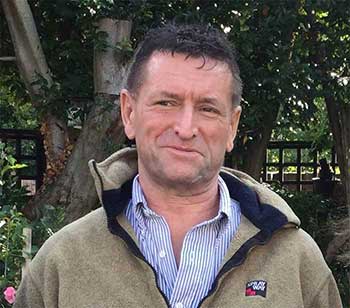
I have lived on the East African coast for over twenty-five years. I have been on more game drives than I can count, spent long afternoons in the back of Land Cruisers watching the Mara from Nairobi to the Tanzanian border, and sat through enough bush breakfasts to write a separate guide. And through most of it, there has been a book. The right book on safari does something particular — it opens a door into the landscape you are sitting inside. The wrong book makes you feel like you are reading on a tube platform that happens to have elephants.
So here, with no apology for the bias, is my personal list of the best books to read on an African safari. Fiction, history, memoir — I have spread it around. All of them belong here.
The Best Fiction Books to Read on an African Safari
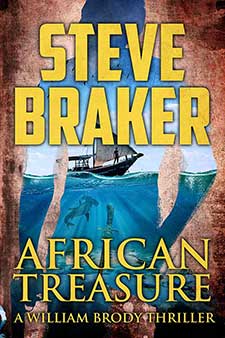
The William Brody Series — Steve Braker
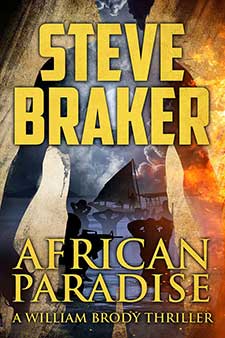
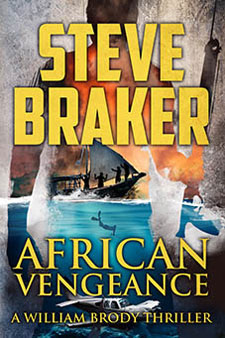
I am going to start with myself, because I live here and I wrote these books for exactly this reason. The six William Brody novels are set on the East African coast — Mombasa, Zanzibar, the Tana River, the Indian Ocean. They are fast, they are grounded in real history and real geography, and if you are sitting in a camp on the Kenyan coast or heading down to Tanzania, these books will put names to the shapes on the horizon.
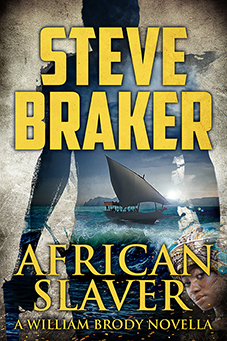
African Slaver opens the series with human trafficking on the modern East African coast. African Ivory takes Brody two hundred miles up the Tana River after a Chinese poacher. African Vengeance runs into the First World War in East Africa — the most underwritten campaign of that war, and one of the strangest. Each book is a door into a piece of this coast’s history that most Western readers have never encountered. The first book is free — there is a link at the bottom of this page. Start there.
If you want to understand what you are looking at when you stare out across the Indian Ocean from a Mombasa beach, the Brody books will help. That is not modesty. It is exactly what I wrote them for.
Out of Africa — Isak Dinesen (Karen Blixen)
You cannot make a list of the best books to read on an African safari without including this one, and I will not try. Karen Blixen ran a coffee farm on the slopes of the Ngong Hills outside Nairobi from 1913 to 1931 — the farm failed, the man she loved died, and she went home to Denmark and wrote one of the greatest books about this continent that exists. Out of Africa was published in 1937 and has never been out of print.
It is not a thriller. It is not fast. It is a meditation on land, loss, and belonging — and it is heartbreaking. If you are going to the Masai Mara or the Ngong Hills area, read it before you go. The landscape she describes is still recognisable.
The Constant Gardener — John le Carré
Le Carré set this novel in Nairobi and the Rift Valley, and the Kenya he describes — the corruption, the aid industry, the sheer moral complexity of modern Africa — is real enough to be uncomfortable. It is a thriller at heart but it carries more weight than most. The Guardian’s review called it his most morally urgent novel. Read it on the flight out. It will reframe everything you see.
The Zanzibar Chest — Aidan Hartley
Hartley was a war correspondent who covered East Africa through the worst of the 1990s — Somalia, Rwanda, the collapse of several states. This memoir is part family history (his father was a colonial officer in Aden), part front-line reportage, and entirely unputdownable. If you want to understand the modern history of the region you are travelling through, this is the book. It is brutal in places. It is also brilliantly written.
A Note on Reading History Before You Travel
The Swahili Coast is one of the most historically rich corners of the planet — Arab trade routes, Portuguese fortresses, the Indian Ocean slave trade, the WWI East African campaign. Most visitors arrive knowing almost nothing about it. That is a waste.
I have written a long guide to the history and culture of this coast that I keep adding to. If you want the background before you arrive — or before you pick up any of the books below — start there.
Read: The Swahili Coast — The Ancient World Hidden in Plain Sight →
The Best History Books to Read on an African Safari
The Scramble for Africa — Thomas Pakenham
In less than forty years — between 1880 and 1914 — the European powers carved up the entire continent of Africa between them. Pakenham tells that story with the pace of a novel and the precision of a scholar. It is a long book — over 700 pages — and it is worth every one of them. The chapter on the East African campaign and the building of the Uganda Railway alone justifies the weight in your bag. This is essential reading for any serious safari traveller. National Geographic has called the Scramble for Africa one of the most consequential periods in modern history.
African Hunting and Adventure — William Charles Baldwin
Baldwin was a Victorian hunter and traveller who spent years in southern and eastern Africa in the 1850s and 1860s. His accounts are politically of their time — no apology from me for that — but as a window into the landscape as it was before the twentieth century, the book is extraordinary. The wildlife he describes would be unimaginable today. Read it as history, not as a model.
The Man-Eaters of Tsavo — John Henry Patterson
In 1898, two maneless lions killed and ate an estimated 135 workers building the Uganda Railway bridge at Tsavo, Kenya, bringing the project to a halt for months. Patterson, the engineer in charge, eventually hunted and killed both lions. His account of doing so is one of the most gripping pieces of colonial-era writing I know. If you are heading anywhere near Tsavo — and most Kenya safari routes pass through it — read this beforehand. You will look at the bush differently.
Practical Notes on Best Books to Read on an African Safari
A few things I have learned from years of reading in the field:
Pack a Kindle. The weight argument is settled. A Kindle weighs less than a single paperback and holds a thousand books. In the heat, a paperback warps and the pages stick together. A Kindle does not care about humidity. The only exception I make is for books I already own in hardback that mean something to me — Blixen stays in hardback on my shelf in Mombasa.
The long afternoons are for reading. Most bush camps have a mandatory rest period between about noon and four o’clock — the heat makes game-viewing pointless and the animals have all gone to sleep anyway. This is your reading time. Two hours in a camp chair with a cold drink and a good book, watching a baobab tree in the middle distance, is one of the better things a person can do.
Match the book to the place. If you are on the coast — Mombasa, Diani, Lamu, Zanzibar — read the Brody series or Blixen. If you are inland on the savanna, Patterson and Pakenham fit. If you are in Tanzania heading for Kilimanjaro, check my blog for more location-specific recommendations.
Leave the books behind for the next guest. Most bush lodges have a small shelf of battered paperbacks left by previous visitors. Add to it. It is one of the better safari traditions.
One More Thing: Learn Twenty Words of Kiswahili First
This is not about books, strictly speaking. But it belongs here. The single best thing you can do before any East African safari — more useful than any guidebook — is learn twenty words of Kiswahili (the Swahili language). Jambo (hello), asante (thank you), tafadhali (please), pole pole (slowly, slowly — the entire philosophy of this coast in two words), hakuna matata (yes, it is real, and yes, the film ruined it).
The reaction from the people you meet will be immediate and genuine. Nobody expects a tourist to speak Kiswahili. When you do — even badly, even with terrible pronunciation — it says something. It says you are paying attention. On this coast, that matters.
The Swahili Coast history and culture guide on this site has a vocabulary callout with the essential words to know before you travel. Read that alongside any of the books above and you will arrive properly prepared.
Start the Safari Reading List Here — For Free
The first William Brody novel — African Slaver — is free. It is set on the modern East African coast and opens with a body on a Mombasa beach and a human trafficking operation running into the Indian Ocean. It is the fastest way I know to put you inside the world you are about to visit — or the world you have just left.
If you are building your list of the best books to read on an African safari, start there. You can always read Blixen on the flight home.
Steve Braker
Mombasa, Kenya