
Princip, a man in despair, sits in a café, his black coffee untouched. His friends, their plan in ruins, are either dead or captured. Gripping his coffee with a white-knuckled hand, he frantically contemplates his escape from Sarajevo. Suddenly, cheering erupts around him, and he looks up, a glimmer of hope in his eyes. A miracle, the gods must be smiling on him at last; his quest is over. With tense and hurried movements, he stands up, pulls the gun from his pocket, and fires twice as Arch Dule Franz Ferdinand drives his open car past his café. Nearby, a butterfly flaps its wings, and the world was changed forever.
In a far-off distance place, a place Princip had never even heard of, a man bends to the whip of his colonialist master and has to sign up for a war he does not understand.
The battle of Lake Tanganyika is full of stiff-upper-lip British audacity and German organization.
Lake Tanganyika, nestled between what was the Belgian Congo on the western side and German East Africa on the eastern side, was the stage for a dramatic naval conflict. By the start of World War One, the Germans had strategically positioned two warships on Lake Tanganyika: the Hedwig Von Wissman and the Kingani. With the declaration of war, Hedwig Von Wissman was armed with pompom guns and sailed to the port of Lukuga in Belgian territory. There, she launched an attack and successfully sunk the Alexandre Del Commune, a French vessel. This bold move marked the beginning of the Battle of Lake Tanganyika.

This decisive act ensured the Germans held the lake, giving them the strategic advantage to transport troops along its length at will, a move that would significantly impact the course of the war.
Enter John R. Lee, a big game hunter and veteran of the Boer War. Lee arrived at the Admiralty to meet Sir Henry Jackson. Lee had been in East Africa and visited Lake Tanganyika, where he had spied on the German ships. He also explained to Jackson that the Germans had built a ship in the Meyer shipyard at Papenburg in Germany and then dismantled it. Packed it into five thousand crates and sent it to Dar-Es-Salaam where it had been unloaded and shipped by train to Lake Tanganyika. The ship was known as the Graf von Goetzen and would be ready to sail in months. With the amount of firepower the Graf von Goetzen could bring to the war effort, the strategic lake would be lost to the Allied forces for the duration of the war.
Strategic Positioning
It doesn’t sound too much of a problem not having control over some lake in the middle of Africa when the Allied forces were desperately battling for ground on the Sigfried Line in Europe. However, for the Germans to attack British and Belgian territory at will, those areas had to be reinforced with valuable troops who were more useful in Europe. The Germans believed any effort to weaken the Siegfried Line in Europe was worth the trouble.
Lee’s plan was simple: find some spare, fast, and maneuverable motor gunboats armed with guns that could shoot shells at least 7000 yards. Pack them up and send them to Africa. Then, transport them through the interior to Lake Tanganyika. Then attack the Germans—simple!
Amazingly, the admiralty agreed to this madcap plan. Sir Henry agreed to the plan with the words, “It is both the duty and the tradition of the Royal Navy to engage the enemy wherever there is water to float a ship.”

HMS Mimi on the Thames with Spicer Simons
They found two out-of-use wooden pleasure boats that the navy had no use for, and then Sir Henry set about finding a man to run this audacious plan.
Jackson passed the task to Admiral David Gamble. Gamble made Lee the second in command and appointed a junior Lieutenant Commander Geoffrey Spicer-Simson, a man who had spent time in the Gambia mapping the rivers but was currently in disgrace for sitting in a café in Ramsgate, with his wife, while his gunboat, HMS Niger, was torpedoed right in front of him. He was then sent to the Admiralty for a desk job transferring Merchant sailors to the War Navy.
Giles Foden describes Geoffrey Spicer-Simson as “A man court-martialled for wrecking his ship, and an inveterate liar and a wearer of skirts.” He had a tattooed torso that he often showed at inappropriate times and would infuriate other naval officers at functions by telling outrageous stories based on his life in China, Africa, and Borneo. Simson felt he was destined for greatness but had always been unfairly overlooked. Although it sounded impossible, this mission would set him on his course to greatness, and for a while, it did!
African Ivory Hunter
Lee was dispatched to Africa to clear the route for the boats. Simson was given 27 men and two 40-foot motorboats. Simson, ever the show-off, said the boats should be named Cat and Dog, but the Admiralty refused his request. He then put forward the names Mimi and Toutou as alternatives, which were accepted. He later explained that these meant “Miaow” and Bow wow” in French, so he got his way anyway. The boats had all unnecessary equipment removed. Then, each one was fitted with Maxim guns and a 3-pound Hotchkiss gun. The Hotchkiss gun had to be fired from a kneeling position, which was dangerous. It was all that could be fitted at the time. Mimi was tested on the Thames on the 8th of June; arrangements had been made for her to race along the Thames and fire at an old derelict building. She fared well and sped along the river, then turned and fired her 3-pound Hotchkiss guns at the building. The crew were pleased as the shell hit the building, but the gun and operator were thrown overboard at the same time! Some last-minute adjustments to the boats enabled them to be put aboard the SS Llanstephen Castle on the 15th of June, 1915 heading for South Africa.
Arriving in Africa
The first leg of Mimi and Toutou’s journey of 10,000 miles was completed after just seventeen days at sea. They arrived in the Cape on this top-secret mission, and Simson immediately donned his Royal Navy dress Uniform and had this man form up and march through the streets of Cape Town. From Cape Town, Mimi and Toutou were loaded onto a freight train and traveled through Bulawayo to Elizabethville, where they arrived on the 26th of July. Then Lee came into his own. He met Simson at the railhead with five thousand porters, steam tractors, and oxen, and they dragged the boats 146 miles overland to Sankisia, another railhead. During the journey, Simson became a true leader. He faced each problem with stoic tenacity. The steam tractors had narrow wheels and were top-heavy, so they kept toppling over. Simson walked the 146 miles with calm reserve, each time a tractor overturned, which was several times a day, he would patiently get the oxen rigged up and right the vehicle. He became a true leader of men and gained the respect of everyone on the mission. When they reached Bukama, the boats were unloaded once again and prepared for the voyage down the Lualaba River, where, despite running aground on several occasions and being forced to hitch a ride on a Belgian river steamer, they reached Lake Kisale and arrived in Kabalo on the 22nd October. From there, it was a short hop on the railway to the Belgian port of Lukuga on the shores of Lake Tanganyika. Simson proudly states in his dispatches that not one of his men had been injured or had been sick during the journey.

Spicer Simons Route to Lake Victoria
Meanwhile, the Germans had not been sitting idly on their hands; I wrote a piece a while ago about the battle of the Rufiji Delta. One of the guns from the Konisgberg, a 105mm quick-firing cannon, had been mounted to the Gotzen.
Spicer’s Plan is Exposed
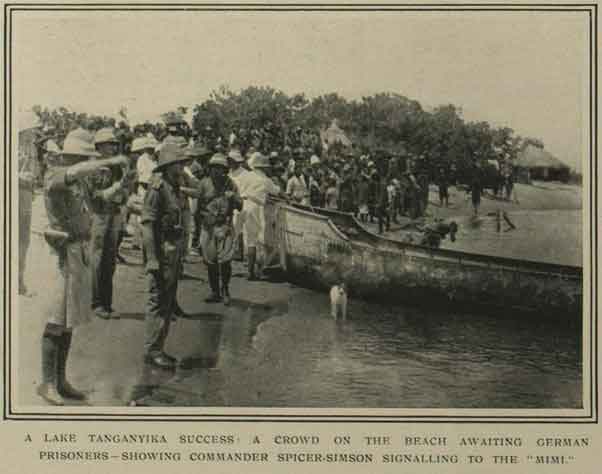
The Germans ran regular patrols along the 700-mile length of Lake Tanganyika. On one of these patrols, Lieutenant Job Rosenthal, commanding the Kingani, noticed a jetty being built and a rough harbor being made from large rocks around Kingani. He approached but was chased away by the shore batteries. So, he decided to make a sorte under the cover of darkness the following night. He swam ashore alone and approached the new jetty. In the heat of the African night, he managed to slip unnoticed into the yard around the jetty, where he found a set of railway lines. He crept along the lines, keeping in the shadows and avoiding the askari sentries posted along the route. As he approached the witching hour, where the night was darkest, and everyone was asleep, he came across an English flag in front of a small encampment. He slipped unnoticed through the camp and continued to follow the tracks. As the sun was hinting its arrival, he dodged more askaris and came across two railway cars. He climbed aboard and found Mimi and Toutou under canvas covers. He immediately knew the British intended to take back control of the lake.
He stealthily leaped from the railway car and landed next to an askari. The Askari was shocked, but he had no time to react as Rosenthal clubbed him to the ground. But the commotion created too much noise, and soon, he was surrounded by angry African askaris. Rosenthal was marched to Simson’s tent and immediately put under officer arrest. He never managed to get back to the Kingani, who presumed he had been killed or captured. However, he managed to send out a secret message written with invisible ink, which he created using his urine. This message was sent via spies along Lake Tanganyika but did not reach Kigoma in time.
Kingani is Captured
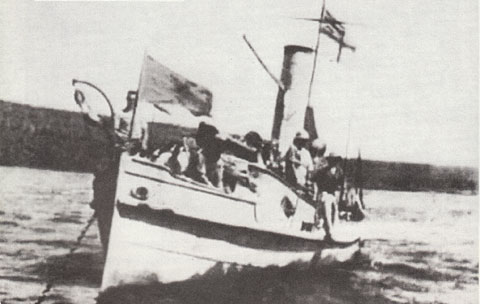
Mimi and Toutou were launched on the 22nd of December after some minor adjustments and fuel and ammunition loading. They did not have long to wait as the next day, during morning prayers led by Spice Simson, the Kingani approached the harbor looking for their lost commander and gathering information. Mimi and Toutou stayed undercover until the Kingani had passed. Once the coast was clear, the two motorboats raced out of the harbor and chased Kingani along the coast. Captain Junge, the replacement for Rosenthal, was surprised to see two-speed boats chasing him with the white ensign of the British. He ordered Kingani’s speed be increased, but he was no match for the smaller, lighter gunboats who quickly caught up. The Kingani’s six-pounder gun was fixed to the bow, so it could only fire forwards, which was virtually the end for the ship as the gunboats sped around her, staying astern and firing the maxim gun. Mimi and Toutou would hound Kingani and then raced off before coming back for another try. Within minutes, the Kingani was hit on her main gun by one of the three pounders. The shell passed through the gun shield and killed Junge outright and the two petty officers he was with. Now almost defenceless and with shells and bullets either striking Kingani or flying overhead, the chief engineer hauled down the colors, and the British took their first prize. The whole altercation lasted 11 minutes. This left Simson at a loss. He had expected a longer, more drawn-out battle and, upon landing on the jetty, retired to his tent and would not come out for several days.
HMS Fifi after being captured
The Kingani was repaired, the gun moved to her stern, and African askaris and local Belgian sailors manned her with an English captain from Simon’s men. She was renamed and enlisted into the British Navy as HMS Fifi. Spicer Simson later explained this meant “tweet tweet” in French to follow the naming conventions of the other boats in his fleet. They were now a formidable fighting force. The Admiralty in the UK were impressed and informed Simons he was to be immediately promoted to Commander.
Spicer Simons’ Long Wait
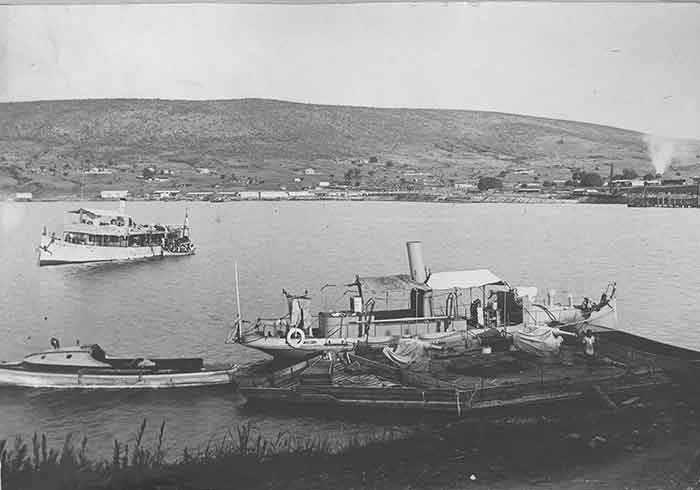
However, due to the 700-mile length of the lake, Simons had to sit and kick his heels as his fleet was not capable of long-distance warfare. And wait, he did. It was not until mid-January that the Hedwig came to investigate the disappearance of the Kingani. Odebrecht, the captain of the Hedwig, scouted close inshore, but he kept clear of the shore batteries that he thought had sunk the Kingani. Odebrecht became bolder and came closer and closer to the harbor, but Simson refused to attack as he believed his smaller craft were not able to take on the Hedwig and guarantee a win. On the 8th of February, Hedwig was ordered to rendezvous with the Gotzen, which was nearby. Hedwig made one last pass of the harbor, which was one step too far for Simons, and he ordered his new armada into Lake Tanganyika, which consisted of Mimi, Fifi, and Dix-Tonne, a patched-up Belgian whaler. Toutou had engine trouble and was left behind. Simson had taken command of Fifi for the attack.
Odebrecht saw the approaching fleet but must have mistaken them for Belgian boats or local craft that did not have the bristling weapons he had. But soon, the white ensigns became clear, and he ordered the Hedwig to make a sharp turn to port. This was either a ruse to get the British flotilla to sail towards the Gotzen, or as he was so close to land, he was hoping the British vessels would flounder on the rocks.
Kigoma Lake Tanganyika
The Hedwig
The pursuing vessels chased the Hedwig, but she had a good head of steam and was managing 9 knots, one knot faster than Fifi. Simons watched in dismay as Odebrecht inched further and further away. His frustrations were so high he ordered Fifi to fire her bow-mounted 12-pounder. The shot sailed wide of the Hedwig, and the recoil stopped Fifi in her tracks. The Hedwig started to pull away, but at the last moment, Mimi sped past Fifi, much to Simons’ dismay, and opened fire on the Hedwig with her 3-pounder gun mounted in the bow. She missed, but the Hedwig could not engage as her stern guns did not have the range. Odebrecht decided to come about and take on the British fleet with his bow-mounted six-pounder. The two circled for a time like cat and mouse, each trying to outmaneuver the other as they fired wildly, missing with every shot. The delay gave Spicer Simons the opportunity to get back in the fight. He had three shells left for his 12-pounder but needed to stay clear of the Hedwig’s bow gun. Simons ordered the first shot of the day, but the shell jammed in the breach, which took twenty precious minutes to clear. Odebrecht took advantage of this and headed to his rendezvous point with the Gotzen.
Fifi’s men cleared the breach and loaded the second to last shell. Simons took his time increasing the speed, trying to reduce the distance between the two ships. This was his moment of glory a real battle with a real battleship. He fired the shot and struck the Hedwig in the hull, causing flooding and slowing her down. Moments later, Fifi’s last shell exploded in the engine room, bursting the boiler and flooding the ship with superheated steam. Five African stokers were killed immediately, along with two Germans. The stricken ship was soon on fire, and Odebrecht gave the order to abandon the ship and set explosives to ensure the vessel could not be refloated and repaired. Twelve Germans, including the captain, and eight natives were captured as they floated in their life raft. Mimi picked up a large German ensign from the wreckage, the first to be captured in the First World War.
Simons did not know the Gotzen was nearby and returned to port a much happier man. He had won his second sea battle almost singlehanded.
The Gotzen
Early the following day, a lookout raced to Simons’ tent and dragged him to the jetty, where the Gotzen sailed majestically past. The crews were racing for their boats, ready for another successful engagement, but Simons forbade an attack as the Gotzen looked formidable with her large, mounted bow guns. Shortly after, Spicer Simons headed to Stanleyville in search of a boat to rival the Gotzen; he was used to winning and did not want his luck to change. He found the St. George, which was ideal and belonged to the British Consul in Banana. He immediately had her dismantled and dragged to Lake Tanganyika, then reassembled. By now, it was May, and the Germans, with their ships either sunk or captured, were in disarray. The Belgians had advanced as far as Kigoma, and the British advance force was pushing north towards Bismarck. Simons was ordered to support the land invasion, so the flotilla consisting of Mimi, Toutou, Fifi, and Venguer, the new ship from Banana, which Spicer had renamed. They arrived off Bismarck on the 5th of June. Simons approached in Toutou and immediately saw the harbor’s defences and decided to withdraw to Kituta.

Graf-Gotzen-Gun from the Konningsburg
Escape and Embarrasement
This allowed the German forces to escape in a fleet of Arab dhows, which upset the army commander, Lieutenant-Colonel Murray. The naval expeditionary force remained at Kituta, awaiting orders. Murray sent his spies into Bismarck only to find that the defensive guns had been made from wood. He sent a dispatch to Simmons reporting the same.
Meanwhile, the British had provided the Belgians with four Short Type 827 floatplanes to attack the Gotzen at Kigoma. Several bombing raids were made, but the planes could not find their target and ended up bombing the empty German shipyard instead. Zimmer, the Captain of the Gotzen, had been ordered by Paul von Lettow-Vorbeck to remove all of the Gotzen’s armaments and replace them with wooden ones, then sail into the lake where she had remained hidden. Kigoma fell to the Allied forces on the 28th of July, but the Gotzen was long gone. She had been taken south to a sandy bay, and after having her engines thoroughly greased and sand placed as ballast, she was scuttled on the 26th of July in 20 meters of water.
Aftermath
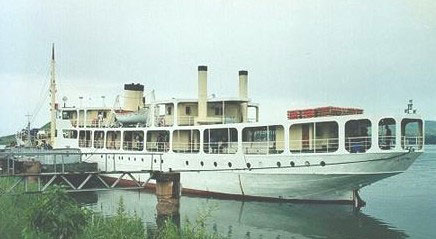
Anglo-Belgian control of Lake Tanganyika was secured in 1916. But the war dragged on for a further two years. The men from the naval expedition were sent back to Britain, where Spicer-Simson was awarded the Distinguished Service Order. Still, he was severely reprimanded for some of his decisions and was never given another command. The Belgians appointed him the Commander of the Order of the Crown and awarded him the Croix de Guerre. The exploits of this mad lake adventure caught the public imagination and were adapted by C.S. Forester for his book The African Queen, later made into a film, The African Queen. The legacy of the Gotzen also lives on; she was raised by the Belgians and towed back to her home in Kigoma, where she promptly sank at her moorings. She was then raised again in 1921 by the British and refitted, which took several years. On the 16th of May 1927, she was launched under the name MV Liemba. The MV Liemba still plys Lake Tanganyika’s coast as the only German Imperial Navy ship still actively in operation.
For loads of useful information on African History and Africa in general just click here
If you would like to get in contact with me then click here
Below are some more useful links about African History- Enjoy!