

Tippu Tip-African Slave Trader
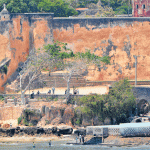
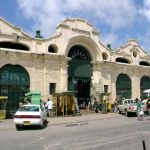
Imagine, a white-walled three-story house in the middle of Stone Town, Zanzibar. A six-foot-tall man, with broad shoulders and a bright white kanzu, is standing on the flat roof in the early evening twilight. He holds a fine porcelain teacup in his hand. As he sips the hot liquid, he surveys his goods chained together in the slave pit below. Some are tied to the whipping post, used to test the strength of each man, woman, and child. Those that scream get sold quickly and cheaply. He has just returned from the interior of Central Africa, his sunburned face has wise eyes that have seen many things, his broad African nose proudly displays his father’s Bantu features, and a perfectly combed white beard hugs his chin. This man is the ultimate hustler for his time, he has made his fortune literally off the backs of others. Not some small crypto con or bank fraud but through abject cruelty, death, and destruction.
Tippu Tip or Tippu Tib’s real name was Hamad ibn Muhammad idn Jum’ah ibn Rajab ibn Muhammad ibn Sa id al Murjabi, quite a mouth full. He was born in 1832, his mother was a Muscat Arab of the ruling class, and his father was a coastal Swahili Arab of the trading class.
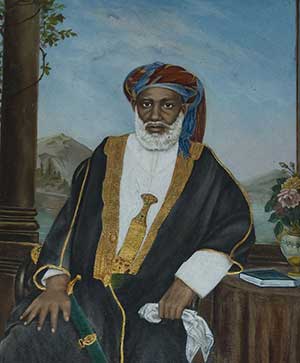
As a child, he was known as Hamad and was educated by his mother and her tutors, which was to serve him well in his adulthood. At a relatively early age, Hamad’s father took him under his wing and sent him on an expedition into Central Africa with a one-hundred-strong team of askaris. They were to collect ivory and slaves for the burgoneing African Slave trade. Hamad took to the task like a duck to water. He found an already well-structured system for buying slaves in the interior of Africa. Whenever a quarrel broke out between neighbouring villages a war party would be sent to attack the offending village and kill or capture any of the occupants. The survivors would then be kept as slaves in the winning village. When Hammad came along, there was already a market for him to purchase from as the chiefs saw no value in keeping their slaves and sold them to Hammad for iron pots and pans, metal knives, and other strange and wonderful items from the outside world.
Soon after his first exploits in Central Africa Hammad was given his nickname Tippu Tu, which means the finder of wealth in Kiswahili. It is said he was either given the name because he constantly blinked when he was talking, or in Tippu Tu’s version it was the fearsome noise his muskets made when his soldiers fired them.
Tippu Tu made his base at Lake Tanganyika on the modern-day border between Tanzania, Zambia, Burundi, and The Democratic Republic of The Congo. With his soldiers and gunpowder, it was not long before Tippu Tu had control over all trade around the lake. But his sights were set on higher goals. Tippu Tu had a keen eye on international politics and knew there was going to be a colonial scramble for Africa. The Berlin Conference in 1884-85 was the commencement of the colonies dividing up Africa among themselves. However, Tippu Tu was ahead of the game and before King Leopold could snatch the whole of the Congo Tippu Tu claimed the Eastern Congo for himself and the Sultan of Zanzibar.
Despite this, he still managed to maintain an excellent relationship with King Leopold II as they had a mutually beneficial requirement.
Rubber was the new gold, and Tippu Tu and King Leopold II had the plantations, but the king did not have the labor force. Tippu Tu, ever the entrepreneur, jumped at the chance and went on a massive manhunt across Central Africa collecting slaves for himself and the king. It is estimated that Tippu Tu alone had over six thousand slaves working his rubber plantations at their height. The cruelty and mass murder on these plantations has been documented in great detail. Here is an article referring to the Rubber Genocide.
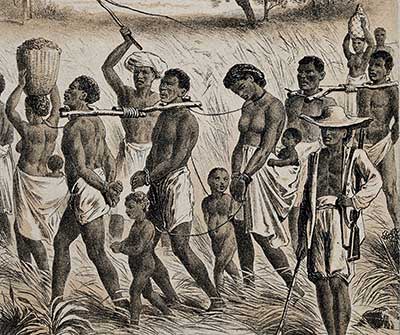
I came across an account by a mariner called Alfred Swan who was tasked with the job of dismantling a boat and carrying it to Lake Tanganyika where he rebuilt it and used it to spread the word of God. On his journey, he met one of Tippu Tu’s slave trains heading back to Zanzibar laden with ivory.
Alfred Swan states in his journal:
“Many of the people we saw filed past us were chained by the neck, others had their necks in forked poles about six feet long which were supported by the people proceeding them. The women carried babies on their backs in addition to a large piece of ivory on their heads. They looked at us with suspicion and fear having been told that white men always desire to release slaves in order to eat their flesh like the upper Congo cannibals. It is difficult to adequately describe the filthy state of their bodies, in many instances not only scared but whipped by a ‘chicko,’ a long fierce-looking leather whip. Their feet and shoulders were a mass of sores made more painful by the massive swam of flies following the foul smell of open oozing wounds and blood. They presented a moving picture of utter misery, and one could not help wondering how any of them had survived the long tramp from the upper Congo at least one thousand miles distant. The head men in charge were most polite to us as they passed our camp. Addressing one, I pointed out that many of the slaves were unfit to carry loads. To this, he smilingly replied, “They have no choice, they must go or die.”
“Have you lost many on the road?”
“Yes, numbers have died of hunger and disease.”
“Have any runaway?”
“No, they are too well guarded. Only those who become possessed of the devil try to escape. There is nowhere they can run to anyway.”
“What do you do when they become too ill to travel?”
“That is simple, we spear them at once.”
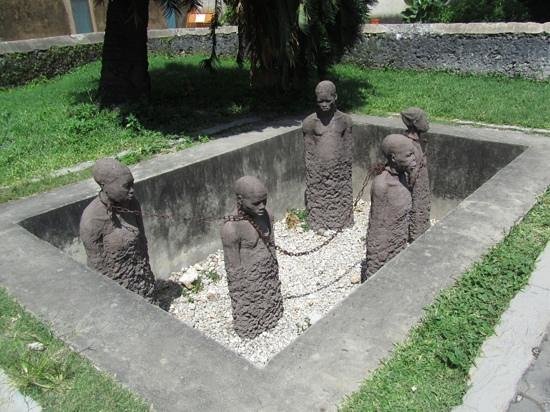
Historians estimate that three out of every four slaves died on these horrific treks across Africa.
In early 1887, the explorer and stateman, Stanley who was in the Congo, with a secret mission to organize a new state called the Congo Free State arrived in Zanzibar and proposed that Tippu Tu be made governor of the Stanley Falls District which would be part of the new state. Both King Leopold and The Sultan of Zanzibar agreed and so one of the most notorious slave traders in history became a government official, what’s new!
When his tenure as governor was up Tippu Tu saw the writing on the wall and realized, he was not going to be able to hold onto his power in and around the Congo as the Europeans were amassing on all sides. He returned to Zanzibar in 1880, where he used his massive fortune to develop seven highly profitable clove farms and manage his ten thousand slaves.
Although Tippu Tu claimed in his autobiography, Maisha, that he was mainly an ivory trader the number of slaves he captured and sold during his lifetime is formidable.
During his life, Tippu Tu collaborated with the explorers Dr Livingston, Stanley, Wissman, and Cameron. Leading several expeditions across the African continent, it is interesting to note that during these expeditions he was also collecting ivory and slaves.
Tippu Tip died on the 13th of June 1905, of malaria in his three-story home in Stone Town, the main town on the island of Zanzibar. The infamous slave market of Zanzibar was closed by the British after the Anglo-Zanzibar War of 1896 and a cathedral was built in its place. The main altar of the cathedral is placed at the exact location of the slave market whipping post.
It is estimated that from the 6th Century to the early 19th Century over 12 million slaves were taken from East Africa and sold to North Africa, the Middle East, and India.
There are also a couple of good YouTube video worth watching: Tippu tip- Notorious Slaver and The Brutal Slave Trade.
Between the North Atlantic Slave Trade and the East African Slave Trade the African Continent lost nearly thirty million people over about six hundred years. That is one hell of a lot of healthy, young people to disappear!
If you would like to follow me on Instagram or Facebook, I post most days just click on the links to join the community.
For loads of useful information on African Safaris and Africa in general just click here
If you would like to get in contact with me then click here
Below are some more useful links about Safaris in Africa- Enjoy!
Top Tips for an African Safari and Beach Holiday
African Safari Which is the Best Country to Choose and Why?
Top Tips for the Perfect African Safari Vehicle
The Naming of Kenya-How and Why!
Zanzibar Tanzania-A must for your Bucket List
A Trip to Monsoon Restaurant Mtwapa
Kerosene Harvesting Stories from Kenya
Mugged by a Trigger Fish Stories From Kenya
Mekatilili Wa Wenza Stories From Kenya