
Queen Victoria described Sir Henry Morton Stanley as an “Ugly determined little man with an awful American twang!” He was indeed determined and, in my belief, a ruthless man who would not let anything get in his way. This did, however, stop him from being buried next to Dr. Livingstone in Westminster Abbey, but more of that later. Henry Morton Stanley is an iconic figure in African exploration. He was one of the first pioneers to open East Africa and managed to accomplish so much in his short life.
Early Years
Henry Morton Stanley is often referred to as an American, but he was British born, into poverty in Denbigh, Wales. To Elizabeth Parry, an unmarried soul of 18 years on the 28th of January 1841. There is some discussion over who his father was as his birth certificate describes him as a bastard. The young child took the name John Rowlands and was brought up by his assumed grandfather Moses Parry. This was not an auspicious beginning for a young lad. When John was five years old his grandfather died, and he was sent to St Asaph Union Workhouse for the Poor. A workhouse was an institution where those unable to support themselves were given a roof over their heads, food and in return they supplied labor. The conditions were awful, and children were often beaten and sexually abused.
John stayed in the workhouse for nine years, which is quite a feat. He even managed to educate himself while he was there. At the age of 15, he ran away from the workhouse and sought the help of his cousin Moses Owen who took him on and educated him further, but his feet were itchy and village life did not suit him. In 1850, John ran away to Liverpool in the hope that another uncle would help him out, but the man didn’t want anything to do with an illegitimate child.
John Rowlands the Adventurer
Henry, ever the adventurer, took a job as a cabin boy on a ship called The Windemere and sailed for New Orleans. While the ship was unloading in New Orleans, John jumped ship rather than face another trip. He managed to find work as a junior clerk. But before long he became restless again and started looking for a better way of life.
He befriended a cotton merchant by accosting him in the street with the words “Do you want a boy, sir?”
Henry Morton Stanley – Born Again
The cotton merchant’s name was Henry Stanley and after some weeks he took John in and gave him lodgings and work in his factory. Ever the chameleon, John decided to raise his status in society by taking the name of his benefactor, Henry Stanley! So, the great adventurer was born on the streets of New Orleans in 1860.
Henry Morton Stanley did not stay long, however, and he soon became bored with his new life so set off to find his fortune. He joined the army and fought on the Confederate side until the battle of Shiloh where he was captured and then offered a position as a Galvanized Yankee and joined the Union Army but was soon discharged due to ill health. When he recovered, he joined the Union Navy. Stanley was possibly the only person to fight for the Confederate Army, the Union Army, and join the Union Navy! He found the Union Navy difficult and his urge to travel on his own terms caused him to desert some seven months later
By The original uploader was Andre Engels at Dutch Wikipedia. – Transferred from nl.wikipedia to Commons., CC BY 1.0, https://commons.wikimedia.org/w/index.php?curid=3551803
An Adventurer is Born
In 1865 Henry Morton Stanley headed for New York and his first steps in journalism. He managed to become an attaché reporter for the Missouri Democrats. He was not a staff reporter, so he only got paid for articles that were printed. But as usual, he had a sly and cunning plan which played to his strengths. Stanley wangled a seat on a wagon train heading to the great American West and joined the gold rush. By August of that year, he had crossed America and reached San Fransico before heading to Denver Colorado. After sending back some excellent reports on his travels he scraped together enough money to organise his first big expedition.
The Ottoman Empire
Stanley and a friend headed for Smyrna in the Ottoman Empire. But on arrival, they were arrested and imprisoned. One report alleges that one of the female parties was even raped. Eventually, Stanley managed to negotiate his party’s way out of prison and even managed to receive some cash for the lost and damaged equipment. Upon being freed, Stanley headed for home where he licked his wounds for a few months then headed back to Missouri.
British Expedition to Abyssinia (1867 -1868)
In 1867 the emperor of Ethiopia, Tewodros II, held a British envoy and others of his party hostage. Stanley pleaded with his new boss at the New York Herald to be allowed to accompany the force that was being sent to negotiate for the hostages. His report on the Battle of Magdala was published before the official army report as Henry Morton Stanley had bribed the telegraph officer. Stanley had his first scoop and was lauded all over New York as an ace reporter. Subsequently, Stanley was sent to report on the Spanish Revolution in 1868. He was then sent to the Middle East, Egypt, Jerusalem, and Constantinople to name but a few.
Finding David Livingstone
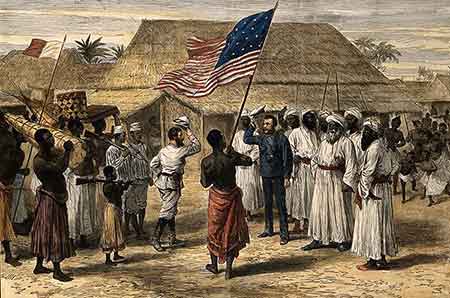
In 1871, Dr David Livingstone had not been heard from in nearly eight months. James Gordon Bennet Jr. the publisher of the New York Herald thought the best person to find the good doctor, either alive or dead was none other than Henry Morton Stanley. So, the legend was born. The story goes that James Bennet called Stanely to his office and said, “Stanley, draw a thousand dollars, and when it is spent draw another and another until you find this Doctor Livingstone.” James Bennet was gambling on Stanley, but he had seen his zeal for a story and his ability to overcome hardships that other reporters were not able or willing to do.
Zanzibar
Henry Morton Stanley left Zanzibar with over two hundred porters. He was reported to be a harsh taskmaster and allegedly hung any porter found stealing. He tramped across Africa for 700 miles (1,100 km) through tropical jungles and open savannahs before he found Dr Livingstone on the 10th of November 1871. If you are interested in Dr Livingstone, then have a look at my earlier Blog here. He claimed to have met the only other white man in the area for some 1000 miles in any direction with the now famous saying, “Doctor Livingstone, I presume?” However, this has been debunked many times. It is believed he created the statement to improve his report to the New York Herald. But it stuck and became famous.
The Herald’s account of the first meeting, published on the 1st of July 1872, reports:
Preserving a calmness of exterior before the Arabs which was hard to simulate as he reached the group, Mr. Stanley said: – “Doctor Livingstone, I presume?” A smile lit up the features of the pale white man as he answered: “Yes, and I feel thankful that I am here to welcome you.”[23
Henry Morton Stanley enjoyed Livingstone’s company and stayed with him exploring the region from Lake Tanganyika to the Nile. On his return, he authored a book called: How I Found Livingstone; travels, adventures, and Discoveries in Central Africa.
First trans-Africa expedition
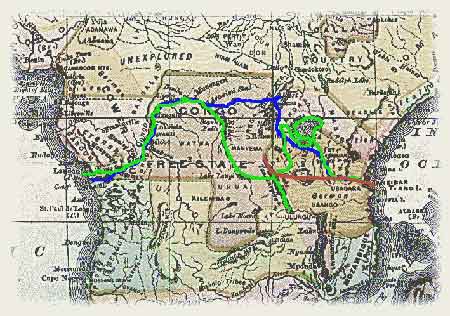
In 1874, the New York Herald, now famous for its African articles financed Henry Morton Stanley on another expedition to Africa. The goal of the expedition was to map the Central African Great Lakes and rivers. Stanley managed to circumnavigate Lake Victoria and Lake Tanganyika and found the source of the Nile in the process. He verified John Hanning Speke’s work that Rippon Falls was the only outlet for Lake Victoria. He then mapped the Lualaba River and surmised that it might flow north and connect to the Nile further downstream. Everyone was so keen to find the source of the Nile at this time as controlling Egypt during the late 1800s was becoming difficult. The powers that be had considered finding the source of the Nile so it could be dammed, coercing Egypt into a more friendly and pliable nation. Winston Churchill tried this during the colonial period by building the Lunatic Express where he planned to take control of Lake Victoria and consequently the Nile. This is now being done by Ethiopia some 150 years later!
Blind Ambition
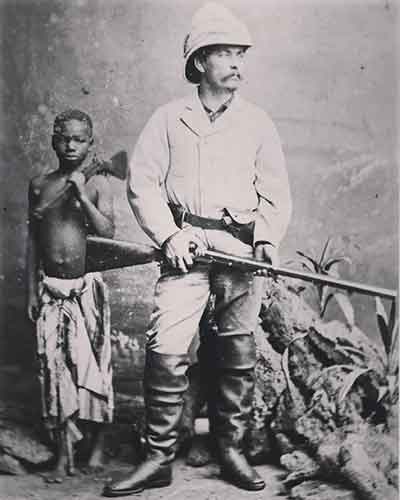
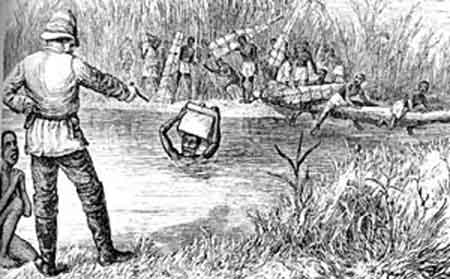
Henry Morton Stanley’s perseverance and cruelty start to show through in this part of his life. The latter part of the expedition was a very tough ordeal for all the party. Stanley left the Lualaba River and decided to follow the Congo River to the Ocean on the West Coast of Africa. The Congo had many long and dangerous rapids. Stanley’s boats were specifically made to be dismantled and manhandled past the rapids. But on many occasions, Stanley became impatient with the hold-ups and forced the men through the rapids killing many of the native porters and most of the Europeans. After 999 days, on August the 9th 1877, he emerged at a town called Boma some 62 miles (100 Km) from the coast. His Muster role started with 228 people and only 114 reached Boma safely with Henry Stanley listed as the only European to survive the journey. He then authored the book, Stanley’s: Through the Dark Continent (1878) which was the first time the phrase The Dark Continent was used to describe Africa.
Upper Congo Expedition
This is the part of Stanley’s life that I find difficult to come to terms with. There are two sides to the story; one being that Stanley was duped by King Leopold II and was not aware of what was to become of the poor Congolese, and two: Stanley wanted to get rich and climbing over dead Africans to get there was fine by him. I don’t believe the first option, Henry Morton Stanley came from very austere beginnings and understood cruelty all too well. He was also no fool and able to change his character and even name on a whim. I am sure he followed the money and was aware of King Leopold II’s true reason for creating the hell that he did in the Congo.
My theory is borne out by the instructions King Leopold II gave when Henry Morton Stanley was sent back to West Africa in 1879.
King Leopold gave Stanley clear instructions: “It is not about Belgian colonies. It is about establishing a new state that is as large as possible and about its governance. It should be clear that in this project there can be no question of granting the Negroes the slightest form of political power. That would be ridiculous. The whites, who lead the posts, have all the power.”[35]
Stanley does complain about his orders but does not do much about it as he was being paid handsomely. He even employed Tippu Tu, See earlier Blog, to find slaves from the Congo Basin to work on the new rubber plantations King Leopold II had built. It could be argued that Stanley introduced the idea of the rubber plantations to the king when he said in one of his dispatches, “There is so much rubber in the jungles, as we walk through them, we are drenched in the stuff from head to foot.”
Leopoldville
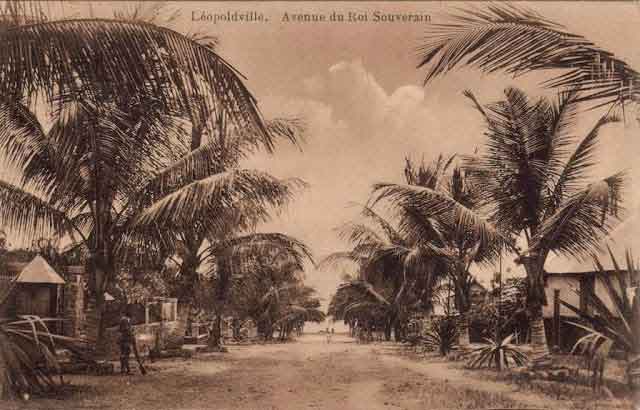
One of Henry Morton Stanley’s crowing achievements was the building of a whole city. In 1882 he built a road from Vivi to Isangila which took nearly two years to construct. When he arrived, a local chief gave him a site near a place called Kintambo to build a city. And so Leopville was built on the hillside overlooking the kingdom. The city was later renamed Kinshasa which today has a population of over 17 million and is one of the world’s fastest-growing megacities.
Sir Henry Morton Stanley’s Later Life
Stanley certainly had an exciting life and managed to accomplish so much. When he had finished with Africa he returned to the UK and married a socialite called Dorothy Tennant. She convinced him to take up politics and he became the MP for Lambeth North. He never really liked politics and never really made any impression on Parliament. Although, true to form he managed to wangle a peerage out of the situation and became Sir Henry Morton Stanley in 1899.
Stanley died peacefully in London on the 10th of May 1904. He was only 63 years old. His family wanted to have him buried next to David Livingstone in Westminster Abbey, but this was not allowed due to the dark cloud that hung over him about the African atrocities which had tainted his name.
I am not sure how many men throughout history with a background and beginnings such as Stanely’s could have accomplished so much in such a short life. He was a true man of his time and took every setback as an opportunity to move forward. Although I don’t particularly like the cruelty and self-promotion that emanates from his stories, I do admire the man.
I have only touched briefly on Henry Morton Stanley’s life here there are many omissions. To cover this gentleman properly is a whole book! But I hope I gave you a taste of one of the world’s great explorers and the man who said the immortal words, “Doctor Livingstone I presume?”
If you would like to follow me on Instagram or Facebook, I post most days just click on the links to join the community.
For loads of useful information on African Safaris, African History, and Africa in general just click here
If you would like to get in contact with me then click here
Below are some more useful links about Safaris in Africa- Enjoy!
The Naming of Kenya-How and Why!
Tippu Tu A Notorious Slave Trader
Koitalel Arap Samosi Freedom Fighter
Mugged by a Trigger Fish Stories From Kenya
Mekatilili Wa Wenza Stories From Kenya